The Greeting at the Door: How Six Seconds Each Morning Is Changing the Way Some US Schools Start the Day
Photo: Rick Obst, CC BY 2.0, via Wikimedia Commons
At 7:40 on a Monday morning, third-grade teacher Marisol Vega stands just outside her classroom door at Roosevelt Elementary in Sacramento, where she has planted herself every school day for the past two years. She isn't checking attendance. She isn't collecting homework. She's doing something that takes, on average, six seconds per student: looking each child in the eye, saying their name, and offering a quick greeting as they cross the threshold.
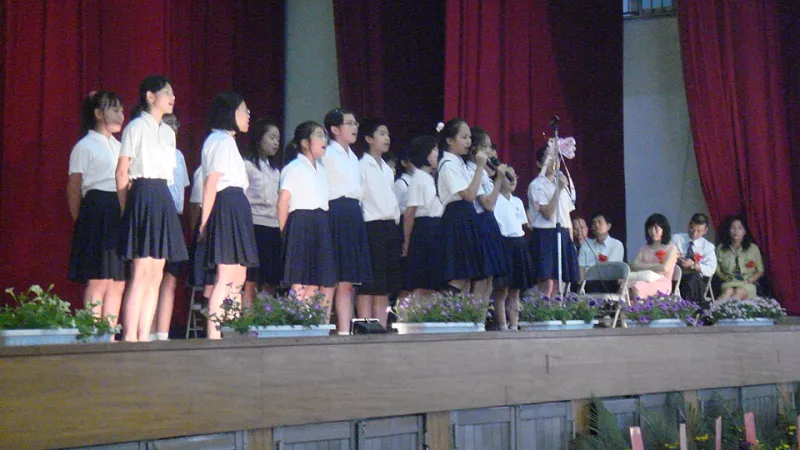
It's a small act. It's also borrowed, deliberately, from a practice that has been woven into Japanese school culture for generations — the idea that a child's day should begin with a moment of genuine, individual recognition. And Vega isn't alone in noticing that something as modest as a morning hello might be doing quiet, serious work.
What the Ritual Actually Looks Like
In many Japanese elementary schools, the morning greeting — often part of a broader practice called asa no aisatsu, or "morning greetings" — isn't an optional nicety. Teachers position themselves at the classroom entrance and greet students as they arrive. Older students greet each other. The principal may be posted at the school gate, rain or shine, exchanging words with every child who passes.
The point isn't politeness for its own sake. Child development researchers describe these brief exchanges as "micro-connections": short, predictable, one-on-one moments that signal to a child you were expected, you were noticed, you belong here. For a seven-year-old carrying a backpack and, sometimes, a rough morning at home, six seconds of being seen can shift the entire emotional baseline of the day.
Dr. Ellen Prado, a school psychologist in Oregon who advises districts on social-emotional learning, puts it plainly: "Kids can't settle down and learn until their nervous system gets the message that they're safe and someone is glad they showed up. A greeting at the door is the cheapest, fastest way to send that message."
The American Experiment
The idea has started to catch on here, thanks in part to a body of research popularized by education figures like Dr. Clayton Cook, whose studies on "positive greetings at the door" found that when teachers greeted students individually, academic engagement climbed and disruptive behavior dropped — with effects that persisted across the school year.
Roosevelt Elementary's version started with a pilot in four classrooms. Teachers were asked to do three things at the door: use the student's name, make eye contact, and add a brief personal touch — a comment about yesterday's soccer game, a nod to a new haircut, a "good to see you."
Within a semester, the school's own data told a story. Office referrals in the pilot classrooms fell noticeably. Attendance ticked upward in a building where chronic absenteeism had been a stubborn problem. And teachers reported something the spreadsheets couldn't quite capture: mornings felt calmer. The transition from home to school, often the rockiest part of a young child's day, had a soft landing place.
Similar efforts have sprouted elsewhere — a middle school in Georgia where homeroom teachers stand at their doors with a rotating menu of greeting options (handshake, high-five, wave, or a simple "good morning" for kids who'd rather not be touched), and a rural K-8 in Vermont where the morning greeting extends to the bus drop-off, with staff greeting kids before they've even reached the building.
Why Such a Small Thing Matters So Much
Psychologists point to a few converging reasons the ritual works.
First, predictability. Children, especially those living with instability, thrive on reliable cues. A greeting at the door is a daily promise: the day starts the same way, with someone expecting you.
Second, name recognition. Hearing your own name spoken warmly by a trusted adult is a low-cost form of belonging. For students who feel invisible — the quiet kid, the new kid, the kid acting out — it's a corrective.
Third, it gives teachers a daily temperature check. Vega says she can spot a lot in six seconds: the slumped shoulders, the child who won't meet her eyes, the one who lingers a beat too long. "That's my early-warning system," she says. "By the time the bell rings, I already know who might need a check-in."
There's also a cultural dimension worth borrowing. In Japan, the morning greeting is embedded in a broader ethic of communal responsibility — the sense that the classroom is a shared space everyone helps maintain. The greeting is the first brick in that structure: you can't build a community around a child you haven't acknowledged.
A Playbook for Bringing It to Your School
The good news for parents, teachers, and volunteers: this is one of the few school-culture interventions that costs literally nothing. Here's how practitioners suggest starting.
Pick the door and commit. The greeting only becomes meaningful if it's predictable. Choose the classroom threshold (or the school gate) and show up every day, even when it's inconvenient.
Keep it to three elements. Name, eye contact, one personal touch. That's it. The ritual should feel warm, not performative.
Offer choices. Some kids don't want a handshake or a big hello. Let students pick their greeting — or opt for a quiet nod. Respecting that boundary is part of the lesson.
Enlist the village. Parent volunteers can cover morning arrival duty at the school entrance. Older students can be trained to greet younger ones, which doubles as a leadership role for kids who need one.
Give it a semester. The research suggests effects accumulate. Track the easy stuff — attendance, referrals, teacher gut-feel — and review after twelve weeks.
Six Seconds, Multiplied
No single ritual will fix what ails an overstretched school system. But there's something quietly radical about a practice that asks adults to slow down at the exact moment the day wants them to rush. In Japan, the morning greeting endures not because it's efficient, but because a culture that raises children together decided long ago that every child should start the day knowing someone noticed they came.
That's a lesson that translates across any border — and it fits in six seconds.