Pass the Peas, Skip the Pop Quiz: What Happens When Families Stop Grading Their Kids at Dinner
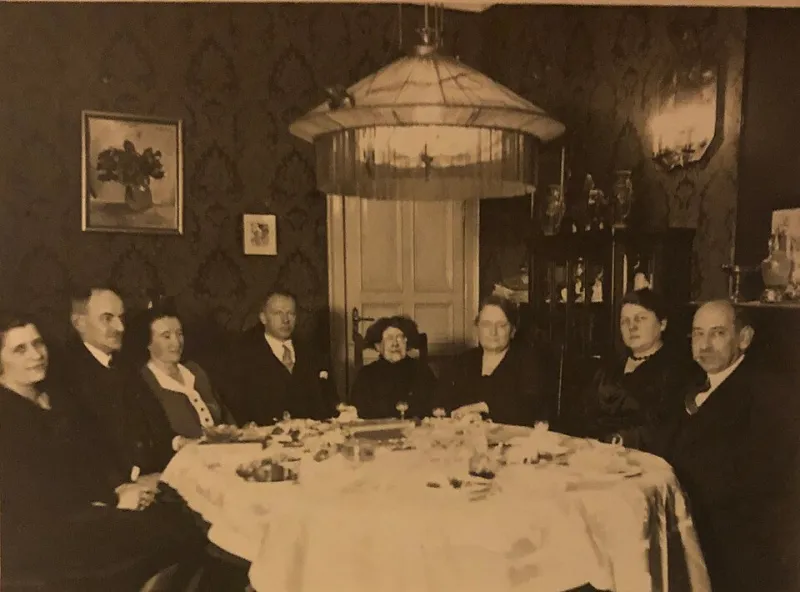
Photo: Hans Bernhard Schwerin, Public domain, via Wikimedia Commons
Somewhere between the mashed potatoes and the 'so how was school today?' question, the American dinner table stopped feeling like a break.
If you've ever watched a kid's shoulders tense the moment a parent asks about the math test, you already know the dynamic. Mealtime becomes a check-in. The check-in becomes an interrogation. And somewhere in there, everyone stops eating slowly enough to enjoy the food.
In many Japanese households, there's a different norm—one that surprised us when we first heard about it. School talk stays at school. The evening meal is protected time, a place where family members talk about anything except academics. Some families call it a ten-minute rule: give it ten minutes of real conversation before anything task-related enters the room, and often, nothing task-related does.
We wanted to know whether that could work in an American context—so we followed three families who tried it for a month.
Why 'How Was School?' Doesn't Work Anyway
Ask any teacher and they'll tell you: 'How was school?' gets you one word. 'Fine.' Every time.
Child psychologists we spoke with say there's a subtler problem. When the first real question of the evening is about performance—homework, grades, the missing permission slip—kids learn that dinner is where they're evaluated. Dr. Elena Marsh, a family therapist in Portland, puts it bluntly: "Kids start editing themselves. They give you the highlight reel, or they shut down, because the table has become a second grading period."
The research on family meals is clear that eating together matters—it's linked to better emotional health, stronger vocabularies, even lower rates of risky teen behavior. But the quality of the conversation seems to be what does the work. A meal full of logistics and lectures doesn't count for much.
The Japanese approach, loosely, flips the script: protect the table from school, and the connection fills the space.
Three Families, Thirty Days, One Rule
The Ramirez family, suburban Ohio. Two working parents, a fourth grader, a seventh grader, and a long history of dinner-table standoffs over missing assignments. Their version of the rule: no school topics after 6 p.m., full stop.
The first week, Mrs. Ramirez admits, felt strange. "I kept reaching for the homework question like it was a reflex." By week three, her seventh grader—previously a one-syllable answer specialist—started bringing up a podcast he'd listened to. Unprompted. "I almost cried over a conversation about octopuses," she says. "I hadn't heard him volunteer information in months."
The Okafor family, Atlanta. With a fifth grader who gets anxious about tests, the Okafors worried that banning school talk would just push the anxiety underground. Instead, they found the opposite. "She started telling us about her worries after dinner, on her own terms," Mr. Okafor explains. "Taking the pressure off the table meant she could actually process things. We didn't lose the conversations—we just moved them somewhere better."
The Chen family, Seattle. Their twist: the kids enforce the rule on the parents. When Dad started asking about an upcoming spelling bee over noodles, his eight-year-old held up a hand: "Ten-minute rule." He reports feeling "gently humbled" and, honestly, a little proud.
What the Kids Said
We asked the children (with parental permission) what changed. The answers were disarmingly simple.
- "Dinner is less like a meeting now." — Maya, 10
- "My mom asks about my day, not my grades." — Jonah, 12
- "I eat more. I guess I'm less nervous." — Lily, 9
That last one stuck with us. A child who eats differently at a relaxed table is telling you something about her nervous system. Kids can't fully relax when they're braced for an evaluation—and neither can parents.
Questions That Build Trust Instead of Transcripts
If you take school off the table, what's left? More than you'd think. The families shared their favorite openers—questions with no right answer, no grade attached:
- "What made you laugh today?" Instantly lower stakes than 'how was your day,' and often funnier.
- "If today was a weather report, what was the forecast?" A sneaky-good emotional check-in for kids who don't do feelings vocabulary.
- "What's something you noticed that other people probably missed?" Rewards observation over achievement.
- "If you could redo one moment today, which one?" Invites reflection without demanding a confession.
- "What are you looking forward to this week?" Turns the conversation toward hope instead of performance.
- "Tell me something weird." Works every single time. Weird is a kid's love language.
Notice what all of these have in common: they ask who your child is, not how your child performed. That's the heart of the practice.
But What About the Homework?
Here's the part every parent wants to know. None of the three families saw grades slip. Homework still got done—at the kitchen counter after dinner, at a set time, with less friction than before. Separating the meal from the assignments actually made the assignments easier to start, because they weren't tangled up with resentment anymore.
Dr. Marsh's advice for skeptical parents: start with just the first ten minutes of dinner. "You don't need a manifesto. You need ten minutes where nobody is asked to account for themselves. See what your kid does with that space. Most parents are surprised."
A Smaller Ask Than It Sounds
The beauty of this idea is its modesty. It's not a parenting philosophy or a screen-time treaty or a chore chart revolution. It's one meal, one boundary, one small act of trust: at this table, you don't have to be a student. You just have to be our kid.
Thirty days in, the Ramirez family's octopus conversations have become a fixture. "We used to talk about school because it was the only thing we could think to ask about," Mrs. Ramirez laughs. "Turns out we were asking about the least interesting thing in his life."
Pass the peas. Skip the pop quiz. The worksheet will still be there after dinner—and so, it turns out, will the conversation.