First Graders, Crosswalks, and a Culture of Trust: What America Could Learn From Kids Who Commute Alone
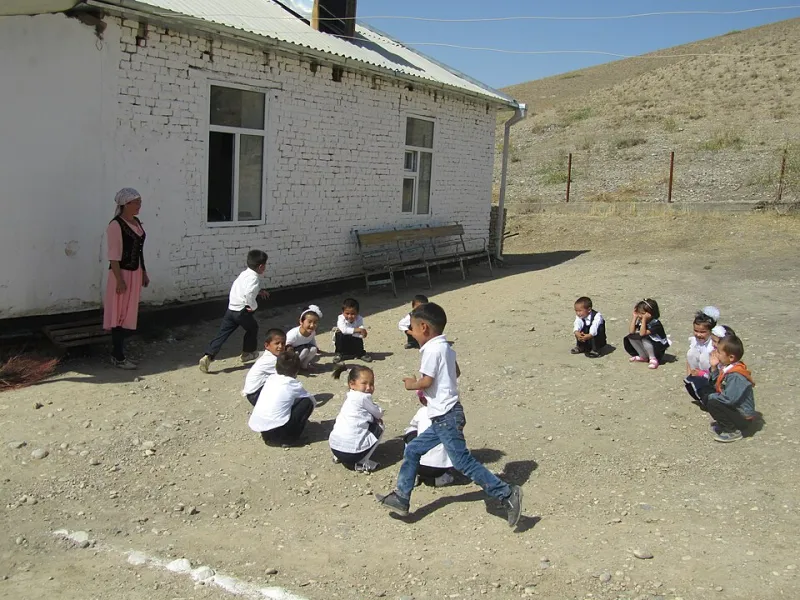
Photo: Nataev, CC BY-SA 4.0, via Wikimedia Commons
Picture a first grader in a yellow hat, backpack bobbing, turning a corner she has turned a hundred times before. In Tokyo, Osaka, or a small town in Nagano, that scene is unremarkable. In most American suburbs, it's practically unthinkable—and in some places, technically reportable.
The distance between those two realities isn't about Japanese children being somehow more capable. It's about what surrounds them: streets designed for walking, neighbors who feel responsible for every passing kid, and a culture that treats a child's commute as a shared public task rather than a private parental anxiety. The good news? Pieces of that scaffolding are being rebuilt in American cities right now, and your neighborhood doesn't need a national movement to start.
How We Lost the Walk
For most of the twentieth century, walking to school was the default in the United States. As late as 1969, roughly half of American kids got to school under their own power. Today, depending on the survey, it's somewhere between 10 and 15 percent—and the steepest decline happened in the shortest trips. Many children now live within a mile of school and still arrive by car.
The reasons pile up quickly. School consolidation pushed campuses to the edge of town, beyond reasonable walking distance. Traffic itself became the excuse: parents say streets are too dangerous, but the danger comes largely from all the parents driving. Add a legal culture that treats unsupervised childhood as a red flag, and a generation of kids has been chauffeured through what used to be their first taste of independence.
The costs are easy to overlook because they're invisible. Kids miss the daily practice of reading a crosswalk, handling a wrong turn, saying good morning to an adult who isn't their parent. Researchers who study what's sometimes called children's "independent mobility" find it correlates with spatial confidence, physical activity, and even mood. And the morning car line, as any parent stuck in one knows, is nobody's favorite part of the day.
The First Train Ride Alone
Contrast that with Japan, where the first day of first grade often includes a solo (or near-solo) commute. This isn't a matter of parents being relaxed; Japanese parents worry just as much as anyone. What's different is the infrastructure of care around the child.
Neighborhood associations map walking routes. Older students in the upper grades are assigned to walk with the youngest ones. Shopkeepers along the main route are informally designated as trusted adults—a kid in trouble knows which door to knock on. Traffic safety instruction starts in kindergarten and is drilled, cheerfully, for months. The famous phrase "first train ride alone" gets applied to these commutes: it's a milestone the whole community participates in, not a risk one family absorbs alone.
None of this transfers to the US wholesale, of course. American metro areas are built around cars in ways Japanese ones aren't. But the underlying idea—that independence is something a community grants to children together, not something parents surrender individually—travels very well.
The Revival Is Already Underway
Across the country, parents and city planners are quietly rebuilding the walk to school.
Walking school buses are the most familiar version: an adult volunteer leads a rotating group of kids on a fixed route, picking up children at their doors like stops on a line. What started as a novelty in places like Chicago and Boulder is now a formal program in hundreds of districts, often supported by federal Safe Routes to School funding that has flowed to states since 2005.
Bike trains take the same idea up a gear. In Davis, California—arguably America's most bike-friendly small city—parent volunteers ride sweep in front of and behind a line of elementary students, teaching hand signals and route logic until the kids can ride it themselves. Portland and Washington, DC have run similar programs.
Walking pools are the informal cousin: two or three families trading off the morning walk, so no single parent sacrifices every day. It's the carpool, minus the car.
And some cities are changing the streets themselves. New York and Seattle have redesigned crossings near dozens of schools. Oakland and San Francisco have closed streets adjacent to campuses during drop-off hours. These "school streets" are borrowed straight from Paris and Tokyo, and the early data on safety is encouraging.
How to Start One on Your Street
The barrier to entry is lower than most parents assume. You don't need a grant or a city council vote—just a route and a few families.
Start with a map. Draw a one-mile circle around your elementary school on paper or Google Maps. Everyone inside it is a candidate.
Find two other families. One is a carpool; three is a walking bus. Post in the school's parent group or chat at pickup. You'll be surprised who's been waiting for someone else to suggest it.
Walk the route together first. Time it, note the crossings that worry you, and pick the version with the fewest arterial roads. Practice it with your kids several times before the first solo attempt.
Recruit the neighborhood's adults. Tell the retiree on the corner what time the kids pass by. Give your kids a short list of houses they can knock on if something goes wrong. This is the Japanese piece you can adopt tomorrow: a corridor of familiar, willing adults.
Then loosen the grip, gradually. The goal of a walking bus isn't permanent supervision—it's training. Most programs aim for older elementary students to walk in peer groups without an adult once the route is well practiced.
If you want institutional backing, ask your school's administration about Safe Routes to School. Most state departments of transportation offer mini-grants for exactly this kind of thing, including reflective vests, route signage, and bike-safety training.
The Point Isn't the Walking
It's tempting to frame all this as exercise or traffic relief, and both are real benefits. But the deeper prize is what happens to a child who regularly walks a familiar route with growing autonomy. They learn that their neighborhood is navigable. They learn that adults other than their parents will help them. They learn, in the smallest possible increments, that they can be trusted with something.
Japan never solved the problem of keeping children safe by watching them more closely. It solved it by making more people watch—not anxiously, but as a matter of course. That's a trade any American street can make. It starts with one family, one map, and one morning when the car stays in the driveway.